

Many Seattle business owners view bookkeeping as a compliance requirement — necessary, administrative, routine. But accurate bookkeeping does far more than prepare a tax return.
When structured correctly, accurate books reduce tax inefficiencies, improve cash flow predictability, increase long-term business valuation, strengthen financing approval, reduce financial stress, and improve strategic decision-making.
In Seattle’s high-cost, highly regulated environment — where Washington B&O tax applies to gross receipts — financial accuracy is not optional. It is leverage.
How Accurate Books Reduce Taxes
Accurate bookkeeping does not “avoid” taxes. It ensures taxes are calculated correctly and strategically.
Proper Expense Categorization Maximizes Legitimate Deductions
When expenses are miscategorized or lumped into generic accounts, deductible expenses may be missed, supporting documentation may be incomplete, and CPA planning becomes reactive rather than strategic.
Accurate bookkeeping ensures expenses are categorized intentionally, documentation is maintained consistently, and deductions are preserved and defensible. Over time, proper categorization reduces overpayment and improves tax efficiency.
Washington B&O Accuracy Prevents Overpayment
Washington’s B&O tax applies to gross receipts — not profit. Accurate revenue tracking ensures correct classification under appropriate tax categories, separation of taxable vs. non-taxable income, and alignment between bookkeeping and filed returns.
Misclassification can lead to paying more than required — or underreporting and facing penalties. Monthly B&O tracking protects both compliance and cash flow simultaneously.
Sales Tax Segregation Prevents Double Payment
Collected sales tax is not revenue. If bookkeeping does not clearly separate taxable sales, non-taxable sales, and collected tax liabilities, businesses may overstate revenue, understate liability, or pay inaccurately.
Accurate books ensure sales tax is remitted properly — not miscalculated. This is one of the most common and most avoidable compliance errors Seattle businesses make.
Strategic Timing of Expenses
With accurate monthly financials, businesses can plan equipment purchases, time investments strategically, evaluate depreciation impact, and coordinate with their CPA for year-end tax planning. Timing decisions require reliable data. Accurate books make proactive tax strategy possible.
How Accurate Books Improve Cash Flow
Profitability and liquidity are not the same. Many Seattle businesses generate revenue but still experience cash strain. Accurate bookkeeping transforms cash flow from reactive to predictable.
Clear Visibility Into Tax Liabilities
Without monthly accrual tracking, B&O obligations feel sudden, quarterly payments feel disruptive, and sales tax deadlines create strain. Accurate books track liabilities monthly, align payments with cash flow cycles, and prevent surprise obligations. Predictability improves liquidity.
Real-Time Expense Awareness
Accurate categorization allows owners to identify vendor creep, rising subscription costs, labor percentage drift, and marketing inefficiencies before they become significant. Small adjustments prevent margin erosion. Margin protection strengthens cash flow.
Revenue Segmentation Supports Smarter Decisions
When revenue streams are segmented properly, businesses can see which services produce higher margin, which offerings dilute profitability, and where pricing adjustments are needed. Growth should follow profitable segments — and accurate books make that clear.
Cash Flow Forecasting Becomes Possible
Cash flow forecasting requires clean historical data, reliable expense tracking, and updated liability balances. Accurate books enable 90-day rolling forecasts, hiring feasibility analysis, vendor payment planning, and seasonal slowdown preparation. Forecasting reduces financial stress dramatically.
How Accurate Books Increase Business Valuation
For Seattle businesses planning to sell, raise capital, secure financing, expand, or merge, valuation depends heavily on financial clarity.
Clean Financial Statements Build Buyer Confidence
Buyers and investors evaluate revenue consistency, margin stability, expense discipline, and cash flow predictability. Inaccurate or inconsistent books reduce perceived reliability — and reliability directly increases valuation.
EBITDA Clarity Improves Negotiation Power
Valuation often depends on multiples of earnings. If bookkeeping is inaccurate, EBITDA may be understated, adjustments become unclear, and buyers discount for perceived risk. Accurate books strengthen your negotiating position and protect the multiple you deserve.
Reduced Risk Equals Higher Multiples
Buyers pay more for predictable revenue, stable margins, clean documentation, and minimal compliance exposure. Accurate bookkeeping reduces risk perception — and reduced risk increases valuation multiples directly.
Financing Approval Becomes Easier
Lenders evaluate cash flow coverage, debt ratios, revenue stability, and expense consistency. When books are clean, loan approval timelines shorten, terms improve, and lender confidence increases. Valuation is not just about a future sale — it impacts your borrowing capacity today.
Why This Matters More in Seattle
Seattle businesses operate in high overhead environments, competitive labor markets, strict B&O compliance requirements, and rapid startup scaling cycles. They are also concentrated in high-valuation industries where investor scrutiny is significant. Small inaccuracies compound faster in this environment — and precision protects opportunity.
The Cost of Inaccurate Books
Businesses that operate with weak bookkeeping often experience CPA cleanup fees, tax corrections, penalty exposure, cash flow surprises, missed deductions, lower financing approval, and reduced sale valuation. These are preventable costs — not the cost of doing business.
Signs Your Books May Be Limiting Growth
- Accounts are not reconciled monthly
- Tax liabilities feel unpredictable
- Your CPA performs frequent corrections
- Financial reports are reviewed irregularly
- Revenue streams are lumped together
- Cash flow forecasting is absent
These gaps limit opportunity — and they are more common than most owners realize.
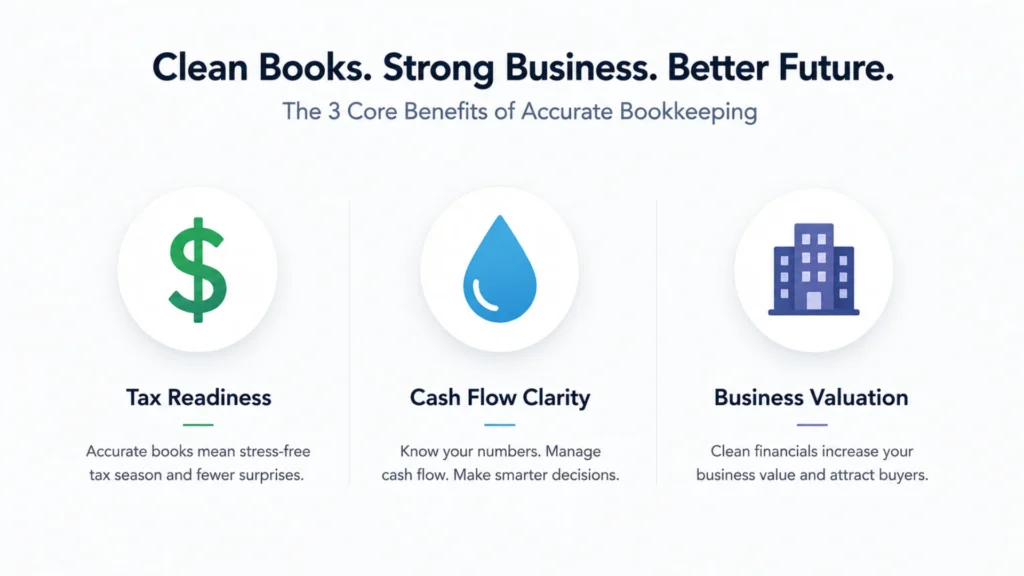
Accuracy Requires Discipline, Not Complexity
Accurate books require monthly reconciliation, consistent categorization, tax accrual tracking, sales tax segregation, regular expense review, and CPA coordination. Automation supports this process. Oversight ensures integrity. Together, they create the financial infrastructure that high-growth Seattle companies rely on.
Accurate books do not simply record history. They reduce unnecessary tax payments, prevent cash flow surprises, strengthen lender confidence, increase business valuation, and support confident decision-making.
In Seattle’s competitive environment, leverage matters. Accurate financial infrastructure creates that leverage — and it is available to every business willing to build it.
Ready to Strengthen Your Financial Foundation?
On Par Bookkeeping LLC helps Seattle businesses build the accurate, strategic bookkeeping systems that reduce taxes, stabilize cash flow, and protect long-term valuation.
A structured review can identify categorization gaps, tax exposure, cash flow blind spots, reporting inconsistencies, and valuation limitations.
Schedule Your Free Financial Review. Seattle companies grow stronger when their books are precise, consistent, and strategically aligned.