
Seattle is home to some of the most innovative, disciplined, and growth-focused companies in the country. Across industries — technology, professional services, healthcare, real estate, construction, hospitality — the businesses that scale sustainably share one common trait:
They treat bookkeeping as infrastructure, not administration.
High-performing Seattle companies do not wait until tax season to understand their numbers. They do not rely solely on dashboards. They do not operate in cleanup mode. They operate with financial clarity.
This guide outlines what high-performing Seattle companies do differently with their books — and how those systems support growth, stability, and competitive advantage. This is not about perfection. It is about structure.
1. They Reconcile Every Month — Without Exception
High-performing companies understand one foundational truth: unreconciled books create unreliable decisions.
Monthly reconciliation ensures bank balances match records, credit card activity is accurate, liabilities are current, duplicate or missing entries are identified, and financial statements reflect reality — not assumptions.
In Washington, where B&O tax applies to gross receipts, inaccurate revenue tracking directly impacts tax exposure. Reconciliation is not administrative. It is financial control.
2. They Track Washington B&O Tax Monthly
Seattle companies operate under Washington’s gross receipts tax structure. High-performing businesses accrue B&O tax monthly, forecast quarterly payments, align revenue categorization correctly, and avoid last-minute tax calculations.
They do not treat B&O as a filing event. They treat it as a monthly operational metric. Predictable tax planning reduces cash flow strain and eliminates the quarterly scrambles that catch so many businesses off guard.
3. They Separate Sales Tax From Operating Cash
For businesses collecting sales tax, high performers track taxable vs. non-taxable revenue clearly, accrue sales tax liabilities consistently, and separate collected tax from operational funds.
They understand a critical truth: collected tax is not profit. Failure to segregate sales tax creates artificial cash flow and real compliance risk. Structure prevents this — and it starts with the chart of accounts.
4. They Review Financial Statements Monthly
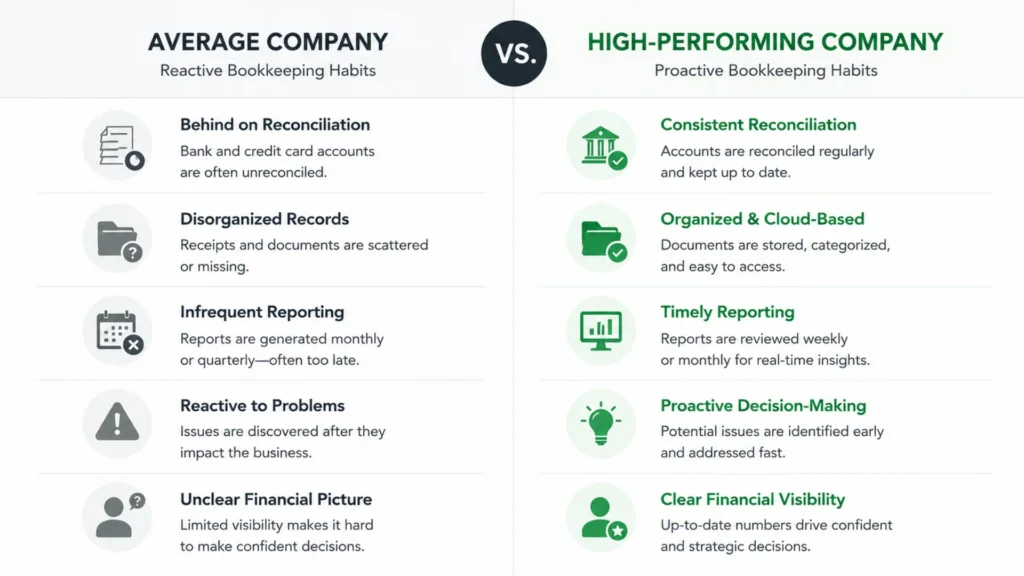
Average companies generate reports. High-performing companies review them.
Each month, they examine Profit & Loss statements, Balance Sheets, Cash Flow statements, margin trends, and expense ratios. This discipline allows them to detect vendor cost creep, labor percentage drift, revenue concentration risk, and margin compression early — when small adjustments can prevent large corrections.
5. They Monitor Cash Flow — Not Just Profit
Profitability and liquidity are different — and high-performing Seattle companies know it. They track rolling 90-day forecasts, align payroll timing with receivables, plan tax payments in advance, and maintain operational reserves.
Cash flow forecasting protects growth. Growth without liquidity creates instability, and Seattle’s cost structure — high payroll, elevated rent, competitive vendor pricing — amplifies that risk quickly.
6. They Segment Revenue Strategically
Instead of lumping all income into a single category, high performers separate service lines, product sales, recurring revenue, project-based income, and subscription models.
Revenue segmentation reveals which services drive margin, which offerings dilute profitability, and where pricing adjustments are needed. Growth should follow clarity — not assumptions.
7. They Use Automation — With Oversight
High-performing companies leverage AI and automation for transaction processing, pattern recognition, document management, and reporting speed. But they pair automation with monthly human review, compliance checks, strategic interpretation, and reconciliation discipline.
Automation increases efficiency for businesses. Oversight protects accuracy. One without the other creates a false sense of control that eventually surfaces as a costly correction.
8. They Align Bookkeeping With CPA Strategy
Rather than relying on year-end cleanup, high performers deliver clean monthly books, coordinate on tax planning throughout the year, forecast estimated payments, and adjust strategy proactively.
This approach reduces CPA correction fees and improves tax outcomes. Tax strategy works best when books are accurate — and accurate books are built month by month, not scrambled together in March.
9. They Track Key Performance Ratios
High-performing Seattle companies monitor gross margin percentage, labor percentage, operating expense ratio, revenue growth rate, customer acquisition cost, and cash runway. They do not guess. They measure. And measurement drives intentional, sustainable growth.
10. They Treat Bookkeeping as Infrastructure
The biggest difference is mindset.
Average companies see bookkeeping as compliance, reporting, and recordkeeping. High-performing companies see bookkeeping as risk management, decision support, tax alignment, cash flow control, and growth infrastructure.
Infrastructure supports momentum. When financial systems are built intentionally, everything else — hiring decisions, vendor negotiations, pricing adjustments, investor conversations — becomes clearer and faster.
Why This Matters More in Seattle
Seattle businesses operate in a competitive, high-cost environment: elevated payroll costs, aggressive B&O enforcement, sales tax complexity, venture-backed scaling pressure, and tight labor markets. Small financial errors compound faster here. Precision protects performance.
The Cost of Operating Without Structure
Businesses that do not adopt high-performance systems often experience CPA cleanup fees, tax surprises, cash flow stress, delayed hiring, margin erosion, and reporting confusion. These are not revenue problems. They are infrastructure problems — and they are solvable.
Signs Your Business Is Ready to Level Up
- Revenue is growing but margins feel unclear
- Hiring decisions feel uncertain
- Tax liabilities feel unpredictable heading into each quarter
- Financial reports are not reviewed on a monthly basis
- Cash flow feels reactive
- You are preparing for financing or investment
Growth requires discipline. The good news is that the infrastructure required is not complex — it is consistent.
What Changes After Installing High-Performance Financial Systems
When bookkeeping becomes strategic, tax payments become predictable, hiring decisions feel confident, margins become measurable, financing approvals become smoother, investor conversations become easier, and financial stress decreases significantly.
Structure improves leadership clarity — and leadership clarity accelerates everything else.

Financial Leadership Starts With Visibility
Owners cannot lead what they cannot see. High-performing Seattle companies prioritize accurate monthly data, consistent reporting cadence, compliance awareness, and strategic forecasting. They operate with intention.
Ready to Build High-Performance Financial Systems?
On Par Bookkeeping LLC helps Seattle businesses move from reactive cleanup to the kind of structured financial discipline that supports real growth.
A structured review can identify reconciliation gaps, tax exposure, margin blind spots, reporting inconsistencies, and scalability readiness.
Schedule Your Free Financial Review. Seattle companies perform best when their financial systems match their ambition.