

Automation has transformed small business bookkeeping. Transactions sync automatically. Expenses are categorized instantly. Dashboards update in real time. Reports generate with a click.
For many Seattle small business owners, this feels like control. But automation alone does not create financial infrastructure.
In Washington’s regulatory environment — where B&O tax applies to gross receipts and sales tax compliance varies by jurisdiction — automation without expertise can quietly introduce risk. This guide explains why financial infrastructure requires more than software, and how Seattle businesses protect themselves by pairing automation with structured oversight. This is not a rejection of technology. It is a call for intelligent supervision.
What Financial Infrastructure Actually Means
Financial infrastructure is not bookkeeping activity. It is the system that supports compliance, tax planning, cash flow stability, hiring decisions, growth timing, lender readiness, and risk management.
Automation handles tasks. Infrastructure ensures accuracy, alignment, and strategic clarity. Without oversight, automation records data but does not protect the business.
Why Seattle Businesses Face Higher Risk From Passive Automation
Seattle companies operate in a high-cost, highly regulated environment that includes Washington B&O tax on gross receipts, sales tax collection and remittance requirements, city licensing thresholds, competitive payroll structures, rapid startup scaling, and industry-specific compliance nuance.
In this environment, even small financial misclassifications can compound quickly. Automation accelerates speed. Speed without validation increases exposure.
Where Automation Performs Well
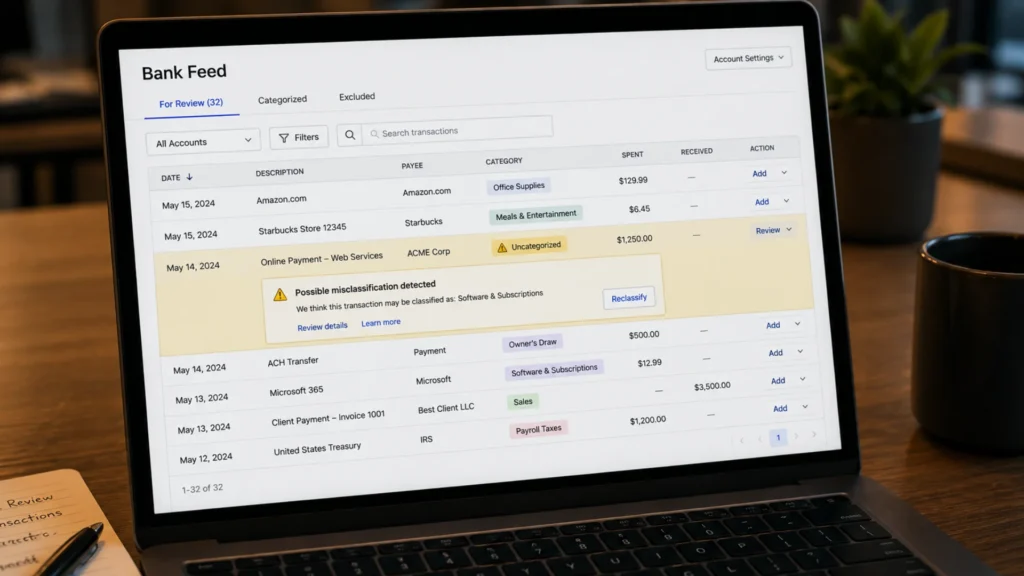
Automation tools provide significant advantages. Transaction processing speed means bank feeds import transactions immediately. Pattern recognition categorizes recurring vendors and expenses efficiently. Document capture attaches receipts and invoices digitally. Dashboard reporting updates financial summaries in real time.
These tools reduce manual workload and increase efficiency. Used correctly, automation strengthens systems. Used alone, it introduces blind spots.
The Hidden Risks of Automation Without Expertise
1. Washington B&O Misclassification
Washington’s B&O tax applies to gross revenue. If revenue streams change — service income expands into product sales, subscription models are introduced, or multi-entity income overlaps — automation may default to historical categorization.
Misclassification impacts tax liability, filing accuracy, and audit risk. Human oversight ensures regulatory alignment as the business evolves.
2. Sales Tax Drift
Automation records revenue. It does not always ensure taxable vs. non-taxable separation, jurisdiction-specific rate accuracy, or collected tax segregation from operating funds.
Collected sales tax is not profit. Without structured monitoring, businesses may unintentionally spend money owed to the state — creating artificial cash flow that surfaces as a crisis at filing time.
3. Reconciliation Gaps
Automation syncs transactions. It does not automatically verify accuracy against bank statements. Without monthly reconciliation, duplicate entries go unnoticed, missing transactions distort balances, liability accounts drift, and financial statements misrepresent reality. Reconciliation is the backbone of infrastructure — and it is the step automation skips by default.
4. Expense Categorization Drift
AI-based systems learn from patterns. If early categorization errors occur, automation reinforces them. Over time, this leads to distorted profitability, missed deductions, misleading reports, and inefficient budgeting. Expert review prevents this long-term distortion before it compounds.
5. Payroll Complexity
Seattle’s competitive labor market increases payroll sensitivity. Automation records payroll entries. It does not align payroll timing with cash flow, evaluate labor percentage trends, assess contractor classification nuance, or monitor tax accrual accuracy. Payroll mistakes escalate quickly. Oversight reduces that risk substantially.
6. False Sense of Security
Dashboards appear polished. Reports look complete. Numbers are formatted professionally. But visual presentation does not equal accuracy. Automation can create confidence without validation — and that gap is often where the most expensive surprises hide.
The Difference Between Tools and Systems
Automation tools are powerful, but tools do not create systems. A real system includes monthly reconciliation protocols, tax liability tracking, revenue segmentation, expense review, forecasting models, CPA coordination, and compliance monitoring.
Automation enhances systems. It does not replace them. This distinction is what separates businesses that scale confidently from those that scale into financial chaos.
Why Seattle Businesses Must Be Proactive
Seattle’s economic environment includes high rent, high payroll costs, competitive vendor pricing, venture-backed scaling, and strict tax enforcement. In this environment, small financial errors multiply quickly. A missed accrual or misclassification can affect cash flow, compliance, and growth timing all at once. Automation alone does not catch these patterns early enough.
What Expert Oversight Actually Adds
Monthly Reconciliation Discipline: All accounts are reconciled to actual statements. Accuracy is confirmed, not assumed.
Real-Time B&O Monitoring: Gross revenue is tracked properly, accruals are updated monthly, and payments become predictable rather than disruptive.

Sales Tax Segregation: Collected tax is separated from operating funds, and liabilities are reviewed consistently.
Strategic Expense Evaluation: Expenses are categorized with tax and margin awareness, patterns are reviewed, and adjustments are proactive rather than reactive.
Cash Flow Forecasting: Accurate books support rolling 90-day forecasts that prevent crises before they develop.
The Long-Term Cost of Automation Without Oversight
When automation operates alone, businesses often experience CPA cleanup fees, tax corrections, penalty exposure, reporting confusion, delayed financing readiness, and cash flow strain. Correction costs always exceed prevention costs.
When Automation Alone Might Work
Automation may function temporarily for sole proprietors with minimal transactions, single-revenue businesses, and early-stage ventures with low complexity. But as revenue grows, complexity increases — and infrastructure must evolve accordingly.
Financial Infrastructure
Modern financial infrastructure includes intelligent automation, structured human oversight, compliance alignment, cash flow forecasting, and strategic reporting. This model combines efficiency with protection, and Seattle businesses benefit from both working together.
Signs Your Financial Infrastructure May Be At Risk
- Accounts are not reconciled monthly
- Tax liabilities feel unclear
- Reports are reviewed irregularly
- Your CPA frequently makes adjustments
- Revenue streams are expanding
- Payroll complexity is increasing
These are infrastructure gaps — not capability gaps. They are entirely solvable with the right oversight model.
Automation With Expertise: The Balanced Model
The strongest financial systems in 2025 use automation for speed, efficiency, and pattern detection — and expert oversight for compliance, interpretation, validation, and strategic direction. Technology amplifies structure. Structure prevents risk.
Infrastructure Protects Growth
Seattle small businesses operate in a fast-moving, high-cost environment. Automation improves efficiency. Expert oversight ensures alignment. Financial infrastructure is not about speed alone — it is about accuracy, compliance, stability, and growth readiness.
Automation without expertise increases risk. Automation with oversight builds resilience.
Ready to Strengthen Your Financial Infrastructure?
On Par Bookkeeping LLC helps Seattle small businesses pair smart automation with expert financial oversight — building infrastructure that protects growth instead of quietly exposing it to risk.
A professional review can identify reconciliation gaps, tax exposure, categorization drift, forecasting blind spots, and scalability readiness.
Schedule Your Free Financial Infrastructure Review. Seattle small businesses perform best when financial systems are structured intentionally — not passively.