

Seattle real estate professionals operate in one of the most competitive and high-value property markets in the country.
Commissions can be substantial. Transactions are complex. Income is irregular. Expenses are front-loaded. Taxes are ongoing. And yet, many agents, brokers, and real estate teams treat bookkeeping as an afterthought until tax season arrives or cash flow tightens unexpectedly.
In Washington State, where Business & Occupation (B&O) tax applies to gross receipts rather than profit, bookkeeping precision is not optional. This guide outlines how Seattle real estate professionals should structure bookkeeping systems for:
- Accurate commission tracking
- Clean 1099 reporting
- Washington B&O compliance
- Sales tax clarity (when applicable)
- Cash flow stability
- Strategic tax positioning
Why Seattle Real Estate Bookkeeping Is Different (And Riskier)
Real estate income does not behave like a salary. It is:
- Irregular
- Transaction-based
- Commission-driven
- Influenced by market cycles
- Dependent on broker splits and referral agreements
Seattle’s high property values amplify this volatility. One strong month may be followed by two slower months. Without structured bookkeeping:
- Commission income is misunderstood
- Tax liability is underestimated
- Cash flow planning becomes reactive
- 1099 reporting becomes chaotic
Bookkeeping must reflect the true rhythm of commission-based business.
Commission Tracking 101: Gross vs Net Income Matters More Than You Think
Accurate commission tracking is the backbone of financial clarity for real estate professionals.
1. Gross Commission Income (GCI) vs Net Commission
Many agents focus only on deposited amounts. But bookkeeping must track:
- Gross Commission Income (GCI)
- Broker splits
- Referral fees
- Transaction fees
- Team splits
- Marketing deductions
If only net deposits are recorded, reporting becomes distorted. Gross revenue matters for:
- Washington B&O tax
- Business performance analysis
- Loan applications
- Income projections
Clarity begins with tracking the full commission structure.
2. Referral Fees and Co-Broker Splits
Seattle real estate often involves:
- Out-of-state referrals
- In-network referrals
- Team-based splits
- Co-listing arrangements
Each payment must be:
- Categorized correctly
- Supported by documentation
- Reflected in 1099 reporting
Misclassification here leads to reporting errors later.
3. Commission Timing vs Closing Dates
Income is earned when deals close — not when contracts are signed. Bookkeeping should:
- Track pending transactions
- Align deposits with closing documentation
- Reconcile brokerage statements
This prevents revenue misalignment and tax confusion.
Washington B&O Tax: The #1 Mistake Seattle Agents Make
Washington’s B&O tax applies to gross receipts. For real estate professionals, that means:
- GCI is taxable under service classification
- Broker splits do not eliminate gross revenue tracking
- Monthly or quarterly filings must align with bookkeeping
Many agents misunderstand this structure. Because B&O applies to gross receipts, Even low-margin months create liability. Monthly accrual tracking prevents surprise payments.
1099 Reporting for Real Estate Professionals: Stay Ahead of January Chaos
Real estate professionals frequently:
- Pay referral fees
- Hire marketing contractors
- Work with transaction coordinators
- Pay assistants or virtual staff
If annual payments exceed IRS thresholds, 1099 forms may be required. Proper bookkeeping throughout the year ensures:
- Contractor payments are tracked correctly
- Tax ID information is collected early
- Totals are accurate
- Year-end reporting is smooth
Waiting until January to reconstruct payments creates risk and stress.
Expense Tracking That Maximizes Deductions (Without Triggering Red Flags)
Real estate professionals often miss deductions because expenses are not categorized properly. Common deductible categories include:
- MLS fees
- Brokerage fees
- Continuing education
- Licensing
- Marketing and advertising
- Photography and staging
- Mileage and vehicle expenses
- Client gifts
- Office supplies
- Software and CRM tools
- Home office (when applicable)
If expenses are lumped into generic categories, deduction clarity suffers. Structured categorization supports both compliance and tax strategy.
Cash Flow Planning for Commission-Based Income in Seattle
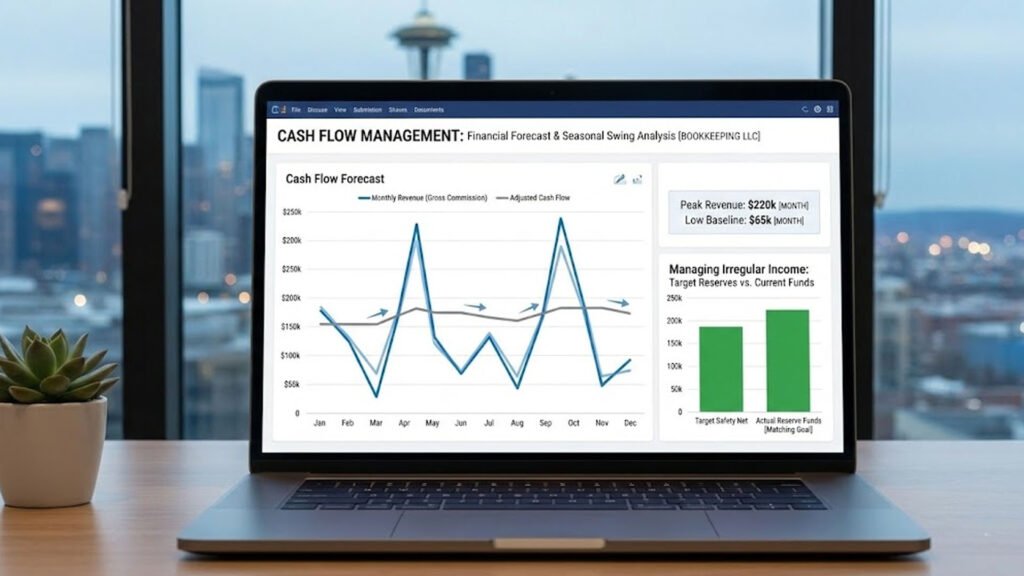
Seattle’s housing market can shift quickly. Without planning, commission-based professionals experience:
- High-income months followed by strain
- Overspending during strong cycles
- Tax shock during filing season
- Inconsistent savings
Bookkeeping enables:
- Monthly tax accrual tracking
- Reserve planning
- Expense pattern analysis
- 90-day income forecasting
Common Bookkeeping Mistakes That Cost Seattle Agents Thousands
Even experienced agents fall into these patterns:
- Recording only net commission deposits
- Ignoring B&O tax accruals
- Mixing personal and business accounts
- Failing to reconcile brokerage statements
- Not tracking referral fees accurately
- Waiting until tax season to organize expenses
These mistakes distort performance metrics and create compliance exposure.
What Proper Real Estate Bookkeeping Should Look Like in 2026
A structured Seattle real estate bookkeeping system includes:
Monthly Reconciliation
Every bank and credit card account reconciled monthly.
Gross Commission Tracking
GCI recorded before broker splits.
Split Documentation
Referral and team splits tracked clearly.
B&O Accrual Monitoring
Tax liability updated monthly.
Expense Categorization
Deductions aligned with IRS and Washington compliance.
1099 Readiness
Contractor payments tracked throughout the year.
CPA Collaboration
Books delivered clean and review-ready.
This system prevents chaos.
Solo Agent vs Real Estate Team: Different Systems, Different Risks
Solo Agents
Focus on:
- GCI tracking
- Personal cash flow stability
- Basic contractor reporting
- Mileage and marketing deductions
Real Estate Teams
Require:
- Multi-agent commission tracking
- Internal splits
- Payroll vs contractor classification
- Advanced reporting
- Performance metrics
Complexity increases with growth. Infrastructure must scale accordingly.
Strategic Tax Planning for Seattle Real Estate Professionals
Proper bookkeeping supports:
- Quarterly estimated tax planning
- B&O forecasting
- Retirement contributions
- Entity structure evaluation
- Cash reserve planning
- Equipment and marketing timing
Tax strategy depends on accurate financial data.
When It’s Time to Upgrade Your Bookkeeping System
You likely need structured oversight if:
- You don’t know your current B&O liability
- You only record net commission deposits
- 1099s feel stressful every January
- Cash flow fluctuates unpredictably
- You are growing into a team model
- CPA cleanup fees are increasing
Growth requires infrastructure.
Why High-Value Seattle Transactions Require Precision Accounting
Seattle’s high-value transactions mean:
- Larger commissions
- Larger tax liability
- Higher exposure
- Increased audit sensitivity
When income increases, scrutiny increases. Clean books reduce risk.
Bookkeeping as a Competitive Advantage in Seattle Real Estate
Agents with structured financial systems can:
- Plan marketing confidently
- Invest in branding strategically
- Hire support staff responsibly
- Weather slow seasons
- Present clean income documentation to lenders
Financial clarity strengthens business stability.

Commission-Based Income Requires Commission-Level Discipline
Seattle real estate professionals operate in a dynamic, high-value market. Commission tracking, 1099 reporting, and B&O compliance must be structured — not reactive.
Bookkeeping is not administrative overhead. It is income protection. When financial systems are accurate and consistent, real estate professionals gain:
- Tax clarity
- Cash flow stability
- Growth confidence
- Reduced stress
- Professional credibility
Infrastructure supports success.
Need Help Structuring Your Seattle Real Estate Bookkeeping?
A professional review from On Par Bookkeeping LLC can identify:
- B&O exposure
- Commission misclassification
- 1099 gaps
- Cash flow vulnerabilities
- Cleanup priorities
Seattle real estate professionals perform best when their financial systems are as strong as their market presence. Schedule a professional bookkeeping review today.